| 1 |
 |
“...as the Winter Reunion. This will do much to make it palatable, and who will want to miss this grand opportunity of renewing and strengthening old friendships ?
Christopher Fairclough has resigned from the Committee as it is now seldom possible for him to get to its meetings, but
we are glad to know that nothing has diminished his enthusiasm for the C.S.A., and that the Association will still be able to count on such help and support as he is able to give from time to time.
It is hoped that one or two younger Chefusians will soon be included on the Committee so that we may keep in close touch with newer members from Chefoo and Ruling.
The General Committee here express publicly their grateful thanks to Doris Hogarth for her good work as New Zealand Secretary from the formation of the branch, and we warmly welcome as her successor, Mary Howie (nee Preedy).
A Merry Christmas and a Happy New Year to you all.
Yours Chefusianly,
J. BERESFORD WELLER,
Hon. General Secretary.
TREASURER’S NOTES
CUBS...”
|
|
| 2 |
 |
“...procession. (We went over to 75 and listened to the first part of the Coronation broadcast on the radio. We heard from when the Queen left Buckingham Palace to when she entered the Abbey and they sang, “ I was glad when they said unto me, ‘ Let us go into the House of the Lord ’ ”. Miss Dickson heard the rest and told us next morning. Miss Stark sent us books and a model of the procession which we cut out and set up before listening to the programme.) The C.I.M. schools are 72 years old now; we feel like a granddaughter of the Chefoo School.
Yesterday we ran races and had lots of fun. It had been raining but it stopped just in time for us to have our sports. Two visitors came to run with us, and friends at 75 came to watch, help with the races and cheer us on. We had running, skipping, hopping, bunny jump, egg and spoon, potato, obstacle and grown ups’ races; it was funny to see the ladies running backwards and the men having a wheelbarrow race ! Mr. G. K. Harris was one of the wheelbarrows...”
|
|
| 3 |
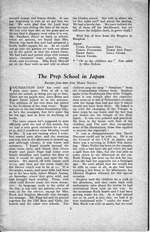 |
“...races. We run with bare feet on the grass and so do not find it slippery even when it is wet. Mr. Faulkner drove us back to school; when we arrived, we found that Mrs. Hatton was back first and had prepared a lovely buffet supper for us. As we could not go into the garden we took our plates on to the porch or into the school room. We had ham and potato chips with tomato sauce, cinnamon toast, pomelo, orange drink, and ice-cream. Miss Ruth Metcalf sat on the floor with us and told us about
the Chefoo school. She told us about the ice five miles out* and about the skating. We had a lovely day. We have rubbed the list of races off the blackboard, but we still have the dolphin there, in green chalk !
With lots of love from the Prepites in Bangkok,
Signed:
Cyril Faulkner. John Cox.
Carol Faulkner. Dorie Ann Frey.
Ricky Frey. Leila Cooke.
Grace Cooke.
* “ Or so the children say.” Note added by Miss Dickson.
The Prep School in Japan
Excerpts from letter from Mary Nicoll
FOUNDATION DAY has come...”
|
|
| 4 |
 |
“...In iHttnorinin
SUSIE ROUGH
On the Prep School Staff, 1921-1935
A FTER many months of distress and suffering, Susie Rough went to “ her
Heavenly Home ” (as she put it frequently to her friends, and to the nurses and doctors) on September 24th, 1953.
Miss Rough joined the Prep School Staff in 1921 and was the teacher of the primary class for nearly all her years in Chefoo. She gave herself enthusiastically to her work and loved it. The writer had many opportunities for long talks with her in the earlier months of her illness, and nearly always the subject was Chefoo days and people. We had many laughs over our memories. Susie was good at telling a joke against herself, as this for example. After the Prep School sports, one of the children wrote in his weekly home letter “ The Long Run was around Miss Rough As Susie was at that time beginning to acquire the middle age spread, she considered this particularly funny.
During her illness, I learned about Susie’s tastes in reading. Her Bible was...”
|
|
| 5 |
 |
“...A History of the China Inland Mission School at Chefoo, China
By DR. F.
Chapter XI
Continuing to qudte from Rev. G. Scott's book “ In Whose Hands ? ”
THE SCHOOLS MOVE FROM CHEFOO TO WEIHSIEN 'T’HE summer was almost over. It had
been a summer tinged with a merciful coolness unusual on the east China coast, and in Chefoo the mellow autumn days could be counted on to hold at bay the rigours of the northern winter for another two months or longer. Then . . . ? But any anxieties concerning a second winter in the houses on Temple Hill were thrust aside by the pressure of present problems. And was it not true that “ Over-anxiety about to-morrow meant doubt if God could be in to-morrow . . . (and that) God never strove to lift His children out of their day-by-day dependence . . .” ? In this confidence, then, each new day was accepted and lived.
Then came the first faint whispering winds of rumour, stealing through the camp . . . “ Have you heard this talk about a move ? ” Another cornered a friend...”
|
|
| 6 |
 |
“...There were some strange containers seen in the queues: a small frying-pan, a soap-dish and several sardine tins. When the Red Cross parcels arrived in January (1945), the tins were almost as welcome as the food they contained, and there was a general smartening up in the way of table-ware. Milk tins were useT for the stews, and jam tins, hammered round the rims, made useful mugs and drinking cups.
Every internee was registered for one of the multitudinous camp jobs, and a selected number of the Chefoo staff were registered on whole-time school duty. This was the result of a staff meeting when, after computing the least number for the running of the School, it was decided the remainder should be made available for general camp jobs.
From a purely scholastic point of view the position was distinctly bettered. Those free from other official camp, duties were able to organize classes, so that at least half a day’s schooling was done. At first some of the classes returned to the luxury and ease...”
|
|
| 7 |
 |
“...marvellous spirit of cooperation and not only church attenders but keen praying Christians, who, though not demonstrative, have a real depth.
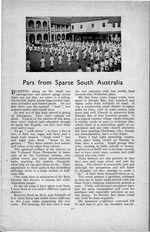
There I had eight preaching centres, each place being visited on Sunday at least once a month. Small groups they were, meeting in halls, schools or homes. It gives you a thrill, not to see large crowds, but to have every man, woman and child attend who can come.
These farmers are also graziers in that they sow and reap wheat and care for sheep. The district is reasonably sure and although not prosperous and still liable to drought, yet they manage to make a “ do ” of their three thousand acres or so.
The youth present a problem, scattered as they are in many small,schools with less than twelve religious instruction periods a year. Virile, red-blooded youngsters have just the same temptations and need for guidance and especially salvation as any city group. In Streaky Bay alone could any work be done regularly.
My missioner neighbour westward fell...”
|
|
| 8 |
 |
“...they were all R.C. I respected this until I learnt that he said the opposite to the R.C. priest ! ! A surprise visit brought to light some interested souls even if he was not. Among them is one family who dearly love the services we have together three or four times a year ! Cruel, isn’t it ? Yet what more can I do being the only minister of any sort who goes there and I have 80,000 square miles to cover. And a real test of faith is to wait on God for the finance to do it.
I am often reminded of Chefoo and the old friends, wondering what they are doing. Occasionally even here we bump into one or two. Sister Ruth Metcalf was reliever on our staff for a while. Dr. Trudinger is down the coast. My sister Joy spent a few days with us on her way to Malaya.
A bright cheerio to all who know that tall slender youth with number 19. Even though the way be rough like the old mule road (I am often reminded of it, bumping across the stoney Nullarbor) keep on plodding on, looking up. Theo. Hayman.
12...”
|
|
| 9 |
 |
“...seven schools, though the population is estimated at under 4,000. There is free education for hundreds of children in the two large State schools; there are three boarding schools, a Girls’ School, a
Maori Girls’ College, and a Boys’ Prep School (where my own offspring is at the moment); and there are two private day schools, one of which I run.
There is good secular teaching in the State schools, but many parents feel that definite religious instruction should be given, so private schools have been established by Catholics, Presbyterians and Anglicans all over the country. Every few weeks letters appear in one or other of the daily papers arguing for or against state aid for these private schools, but the policy remains unchanged. A recent Dominion Federation of School Committees Associations puts the position clearly—“ This conference reaffirms its support of the existing system of free compulsory and secular education. . . . We have no objection to people establishing schools outside...”
|
|
| 10 |
 |
“...boy home to school in England).
As Christmas and the summer holidays approach, life grows more and more hectic. Most of my girls go on to the Girls’ Boarding School here, and many of them have brothers at the Boys’ Prep School (shades of Chefoo !) Some families have children at all three schools, so our end-of-year functions have to be arranged carefully to avoid a clash. This means that the first two weeks in December are one wild series of sports days-, concerts, school plays, and prizegivings, to say nothing of the teacher’s contemporary effort of marking exam papers, buying prizes, and preparing speeches.
At last the final day arrives. I mount the platform with the Vicar (Chairman of the School Committee), the President of the Parents’ Association, and the Guest of Honour who is to present the prizes. I exhibit surprise and pleasure each year at being offered a beautiful spray of flowers by the smallest child in the school; I listen to speeches and make my own report; I read out the...”
|
|
| 11 |
 |
“...masters—which few schools anywhere could equal or surpass.
Barely a hundred “ boarders ”, plus a handful of lads from local families, made up the Boys’ School roster of that day. Yet from this small company of four decades ago the world was to hear from several in quite ringing terms and it will go on hearing from them for some years to
come.
This pre-World War I generation of Chefusians, moreover, gave its full share of young men to the fighting services of Britain, the Commonwealth countries and the United States. It paid its generous quota of supreme sacrifice in the long roll of casualties that stretched from First Ypres and the Somme to beaches of Normandy, the Rhine crossings and the landings of the Pacific. The names of Terrence McCarthy, Henry Whittlesey and Theodore Emslie stand out, in my own memory, among a much larger group of gallant Chefoo graduates who underwrote their devotion to freedom with their lives.
Since boys from the British Isles predominated at Chefoo, and also because...”
|
|
| 12 |
 |
“...to hold my own labours in sharp perspective with the whole ”.
Kenneth Taylor was a quite different type of schoolboy from Luce: scholarly, gentle, cool, devoid of visible enthusiasms, an excellent athlete, a firm and first-rate head prefect, he disdained the close conformity which would have won him the coveted Chefoo “ Conduct Prize ” in 1915. Maturing much more slowly than either Luce or Wilder—who had created international reputations in their twenties—-Taylor’s career is the slow, steady but sure accumulation of experience, the ripening of wisdom, and the moving from one position
of exceptional performance to successively higher and more difficult levels. After leaving Chefoo with a first class in the Oxford Senior “ Locals ”, he completed his basic professional training, with distinction, at McMaster and Chicago Universities and with the Brookings Institution in Washington, D.C.
Retained as an expert adviser on various Royal Commissions and Imperial Conferences during the inter-war...”
|
|
| 13 |
 |
“...out, by two seconds, over Thornton for third place in the Chefoo Long Run. But Thornton was, even then, the all-round healthy athlete upon which his whole vigorous, meteoric career has been safely founded.
Thornton’s non-conformity, and his sense of drama—so often the common characteristics of those destined for greatness—burst out in occasional high-humoured flashes. Being an American, and having become a faultless cricketer by Chefoo standards, he set the cricket field “ on its ear ” one day by bringing out a complete set of baseball equipment. Thornton proceeded to teach senior Chefoo how to play his native game as it should be played, to the high delight of the junior school, who quickly learned to jeer and taunt the pitcher like the best denizens of Brooklyn or the Bronx. The masters, with tolerant yet puzzled smiles, watched from the dignified seclusion of the music rooms in the west wing. For two gay, uninhibited hours Chefoo “ went American ”; and the decorum of the cricket pitch...”
|
|
| 14 |
 |
“...io/- per week for each child.
The care of-the delinquent child or young person is handled almost entirely by the State. Their policy of open Institutions, such as the well-known Burwood Girls’ Training Centre and their farm schools for boys have proved without doubt their value, for this particular type of problem. There is also the Borstal system for the older delinquent.
Of the Church groups throughout New Zealand many have their own homes for children. The Anglican group have fourteen homes in all accommodating 390 to 400 children. The Methodists have a large home in Christchurch with about sixty boys and girls. The Baptists have a home in Auckland. The Roman Catholics have, of course, quite a large number of institutions. The Presbyterian Social Service Association, which is the agent of the General Assembly of the Presbyterian Church, although each province has its own legal status, has perhaps the largest
number of homes, eighteen in all. In practically every district they are using...”
|
|
| 15 |
 |
“...Helen and Anne Lea, Mrs. Lindsay, Joe Liversidge, Myrtle Ludbrook, Mary Lutley, Mrs. Mason and friend, Gertrude Nunns (nJe Briscoe), Jean, Mary and Margaret Pearce, Miss Phare, Clarence and Edith Preedy, Miss Pyle, Mrs. D. de B. Robertson, Misses H. E. and M. E. RoSertson, Doris and Olive Rouse, Mrs. Rowe, Christopher Rowe, Bea Stark, Kathleen Strange, Alice Taylor, Dr. and Mrs. W. J. Toop, Margaret Vinden, Mr. G. P. Welch, Sylvia and Beryl, J. Beresford Weller.
Toronto. September 26th, 1953
A Chefoo Reunion- was held amidst the bursting of balloons, eating crackers, and
REPORTS
whistling unrecognizable tunes. While this was going on, some parcels were let loose among the crowd, with a “ yes ” or “ no ” penalty. Then there was the game of cranking the car; or was it washing the elephant ? The grand highlight of the games was the leg roping of cows and the stampeding of cattle—no; just a minute, that can’t be right. Oh yes, now I remember ! It was the gentlemen tying a short piece of string...”
|
|
| 16 |
 |
“...know that she is grandma to eight little children—four boys and four girls ! Three of the boys live near and come up every Sunday morning for family prayers. Her sister Lily, MRS. HARRY FRIER, paid a flying visit late in the summer, coming first to Mrs. Gallis, who took her over to Dublin to see her daughter, and then to Wellingborough.
MARJORIE COOK (nee STOBIE) recently met the Rev. Harry Truelove, who was a colleague of her father in Chekiang; he had just met a teacher who knew Marjorie in Chefoo, but could not remember her name. Can the teacher oblige with further details please ?
RUTH CROCKETT is attending Christ’s Hospital, Horsham, while her mother is in Ceylon. During the holidays she went to an I.S.* Camp at St. Anne’s near Blackpool, which she enjoyed very much. Ruth also spent some time in South London where she met ROSEMARY PHILLIPS and the GUINESSES.
Although MR. COWAN DICKIE finds his time is booked up, he still has time to witness for his Master and finds his field of activity...”
|
|
| 17 |
 |
“...refreshing his Chinese by doing some translation of Esther and Job for the missionary recruits next year.
CARRIE MANN is still Home Sister at Royal Surrey County Hospital, Guildford. She writes: “ I am still running Rangers, or do they run me ? I have taken on the job of County Ranger Adviser for a year, but am not sure yet what it is all about ! Kathe Wehmeyer is through her first year here and has just taken her Prelim. I had a good camping holiday again this year—would like to have had some Chefoo Rangers with us ”.
On October 16th MRS. RACHEL MORRISON, Dorothy (six-and-a-half) and Neil (two years) sailed for Singapore, having settled George in Monkton Combe School. They gave up their house in Blairgowrie at the end of June and have been “ in and out of suitcases ” ever since. Mr. Morrison is in Singapore waiting their arrival.
MR. and MRS. MUDDITT have both passed their seventieth birthdays, and are keeping fit and well. Mr. Mudditt saw MR. FRANK MCCARTHY a short while ago; he seemed...”
|
|
| 18 |
 |
“...National Railways. DOROTHEA (Kalim-pong) has entered fifth year high school, and "works in the week-ends for Loblan’s groceterias. MARY often hears from LYDIA MILLER {nee Rivkin) who is living in San Francisco.
MRS. CARLBURG, who is in charge of the Chefoo hostel in Wheaton, gives news of the Chefusians in the Wheaton-Chicago area. “ MISS TAYLOR has asked me to send you some news of Wheaton and Chicago Chefusians, which I am glad to do, though there seems little of interest apart from the fact of there being quite a group here. The following are in Wheaton College, MARY RUTH HOWES, part-time teaching and studying for M.A. on a two-year fellowship, HAROLD ADOLPH and ELDEN WHIPPLE, senior and pre-medical, HERBERT CARLBURG, junior and President of the Chefoo group, CLIFFORD CARLBURG, CHUCK CRAPUCHETTES, JOAN THOMPSON and ENID GRAHAM, sophomores, FLORA NELL HOWES and GLADYS and TOM TWEDDELL, freshmen. The TWEDDELLS drove through from Washington by themselves. The car was rather ancient, but got them...”
|
|
| 19 |
 |
“...Thames. Then we headed back to London to claim our ‘ privileged Canadian seats ’ for the Coronation (but even they did not keep out the rain). Chefusians we visited en route included MISS LUCIA, KAY ROUSE, MRS. MARTIN and ELIZABETH, and JOHN ROBERTSON and his family in Oxford. Other classmates I saw were JOAN YOUNG (now in her last year of medicine at Edinburgh University), JOY MAXWELL (teaching in London) and MOLLIE ROBERTSON (now at Glasgow University). I was very glad to be able to attend the Chefoo reunion in London with my sister and her
29...”
|
|
| 20 |
 |
“...BETTY HEWITT is the corresponding secretary in the Toronto office. RUTH BELL, after graduating from the Ontario College of Education, the high school teachers’ training college, has recently joined the staff of the I.V.C.F., as stated above. She was dining-room hostess this summer in the Campus in the Woods, which is a camp run by the I.V.C.F. for university students in Ontario. FRED WOODBERRY likewise is a recent recruit. He will be in Minnesota.
PETER PICKENS turned up at the
recent Toronto Chefoo reunion, having, if the secretary’s information is correct, travelled from New York to do so. Something of a record, surely, in both travel and devotion.
KATHARINE COSTERUS QUILTY writes: “ MARTHA JANE HUTCHINS {nee MOORE) and her husband have a church amongst the English speaking population in Guatemala. Their address is Apartab, Postal 631, Guatemala. Both their children are learning to speak Spanish fluently. There are about 600 Chinese, but MARTHA says they all speak Cantonese. JEAN DILLEY...”
|
|